Shunda Road, Lincheng Town Science and Technology Industrial Park, Xinghua City, Jiangsu Province
 English
 русский
 Español
 عربى
عربى
The right heat treating basket is the one matched to your specific process temperature, atmosphere, part geometry, and load weight — there is no universal solution, and using the wrong basket costs money through premature failure, part damage, and uneven thermal cycling. A heat treating basket (also called a furnace basket, heat treat tray, or high-temperature workholding fixture) is a fabricated or cast container used to hold, transport, and position metal parts during thermal processing operations including annealing, hardening, carburizing, nitriding, tempering, and sintering. This guide covers every major basket type, the alloys used to build them, how to calculate load capacity, and how to extend service life in demanding furnace environments.
Content
- 1 What Is a Heat Treating Basket and Why Does It Matter?
- 2 The 6 Main Heat Treating Basket Types and Their Applications
- 3 Which Alloy Should Your Heat Treating Basket Be Made From?
- 4 How to Size a Heat Treating Basket for Load Weight and Part Geometry
- 5 Heat Treating Basket Performance by Process: A Direct Comparison
- 6 Why Heat Treating Baskets Fail Prematurely — And How to Prevent It
- 7 How to Extend Heat Treating Basket Service Life: Maintenance Best Practices
- 8 Frequently Asked Questions About Heat Treating Baskets
- 8.1 How do I know when a heat treating basket needs to be replaced?
- 8.2 Can I use a standard stainless steel basket in a carburizing furnace?
- 8.3 What mesh aperture size should I use for small parts like fasteners or bearings?
- 8.4 Why do heat treating baskets warp, and can warping be prevented?
- 8.5 How much does a heat treating basket cost, and what drives the price?
- 8.6 Should I use a liner or separating medium inside my heat treating basket?
- 9 Summary: How to Select the Right Heat Treating Basket for Your Process
What Is a Heat Treating Basket and Why Does It Matter?
A heat treating basket is a purpose-engineered fixture that ensures parts are uniformly exposed to furnace atmosphere and temperature while being safely contained during handling, quenching, and transfer between process stages. Without a properly designed basket, parts pile unevenly onto furnace hearths, block gas circulation, contact surfaces that contaminate or shadow them from heat, and create unsafe conditions during quench tank immersion.
The economic case for correct basket selection is direct. A well-matched heat treating basket in a carburizing furnace operating at 1,700°F (927°C) may achieve 500–800 thermal cycles before replacement. A basket made from the wrong alloy or with the wrong design for that process may fail in as few as 50–100 cycles — a 5× to 8× difference in per-part processing cost attributable entirely to fixture selection. For a production facility running three shifts, six days a week, that difference translates to tens of thousands of dollars annually in basket replacement cost alone, before accounting for lost throughput from unscheduled maintenance.
Heat treating baskets serve four functions simultaneously:
- Containment — keeping parts together as a batch through furnace, quench, and wash stages
- Positioning — orienting parts for uniform atmosphere and temperature exposure on all surfaces
- Thermal mass management — acting as a controlled thermal buffer or conductor depending on design
- Mechanical protection — preventing part-to-part contact that causes surface damage, soft spots, or distortion during quenching
The 6 Main Heat Treating Basket Types and Their Applications
1. Wire Mesh Baskets
Wire mesh heat treating baskets are the most versatile and widely used design, offering excellent atmosphere circulation for carburizing, nitriding, and annealing of small-to-medium parts at temperatures up to approximately 2,000°F (1,093°C). The open mesh structure — typically woven from high-temperature alloy wire in square or rectangular apertures from 1/4 inch to 2 inches — allows furnace atmosphere, radiant heat, and quench media to reach all part surfaces simultaneously. Mesh baskets are available in rectangular, cylindrical, and custom geometries and can be fabricated with solid side walls combined with mesh floors, or as fully open mesh on all surfaces.
- Best processes: Carburizing, carbonitriding, gas nitriding, annealing, normalizing, tempering
- Temperature range: Up to 2,000°F (1,093°C) in standard alloys; up to 2,200°F (1,204°C) in high-nickel alloys
- Load capacity: Typically 200–2,000 lbs depending on wire gauge, mesh aperture, and basket dimensions
- Weakness: Lower structural rigidity than cast or fabricated plate baskets; mesh can distort under very heavy or concentrated loads
2. Fabricated Bar or Rod Baskets
Fabricated rod or bar baskets provide higher structural rigidity than wire mesh designs and are preferred for heavy loads, large parts, and applications where mesh-aperture bridging would allow small parts to fall through. They are constructed from solid or hollow round bar, square bar, or flat bar welded into a grid or ladder pattern. The spacing between bars — typically 1 to 4 inches — is sized to the smallest dimension of the parts being processed. For parts with a minimum dimension of 2 inches, 1-inch bar spacing is standard to prevent drop-through while maximizing open area for atmosphere flow.
- Best processes: Hardening, normalizing, solution annealing of large components, forging pre-heat staging
- Temperature range: Up to 2,200°F (1,204°C) with appropriate alloy selection
- Load capacity: 500–5,000 lbs depending on bar size and alloy
- Weakness: Higher thermal mass than mesh; longer heat-up and cool-down times per cycle
3. Cast Heat Treating Baskets and Trays
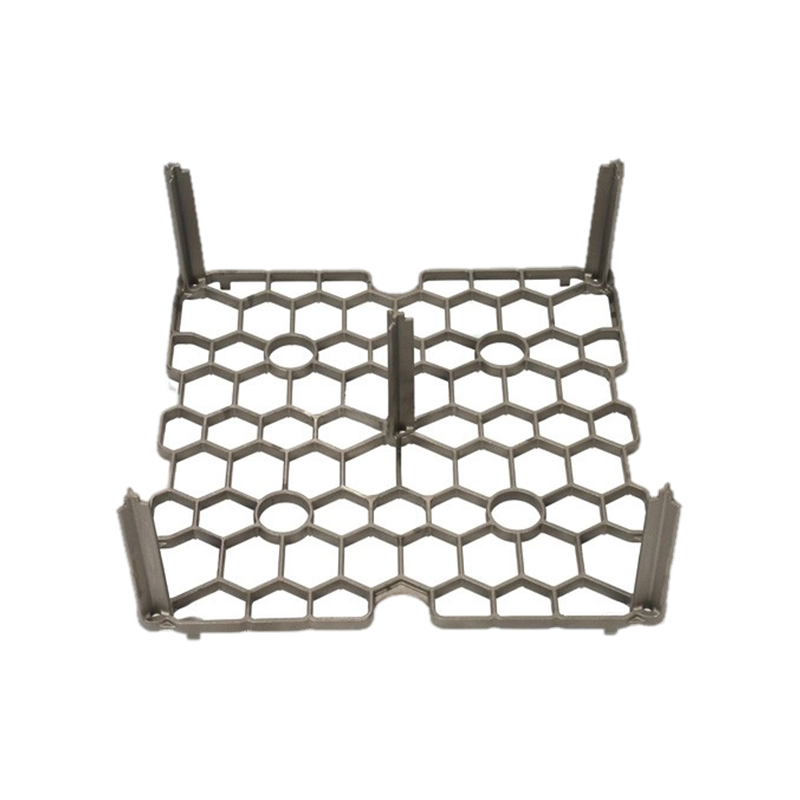
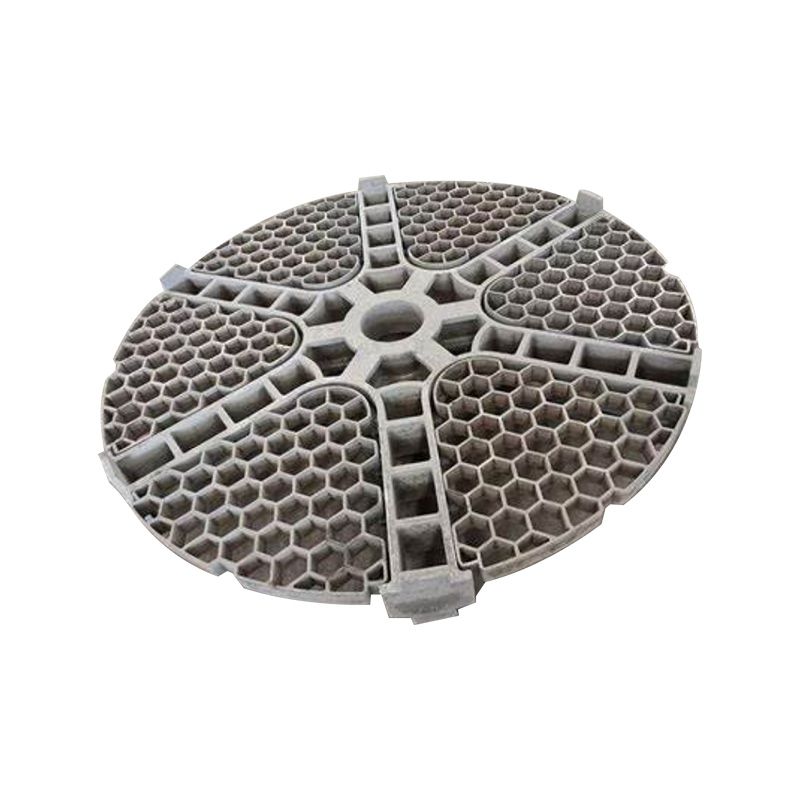
Cast heat treating baskets and trays offer the highest dimensional stability and resistance to creep at extreme temperatures, making them the preferred choice for continuous belt furnaces, pusher furnaces, and sintering operations above 2,000°F (1,093°C). Cast baskets are produced by sand casting or investment casting in high-alloy compositions — most commonly HK-40 (25Cr/20Ni) or HP alloy (26Cr/35Ni) — that resist the oxidation, carburization, and creep deformation that destroy fabricated fixtures at the highest process temperatures. Cast designs typically have a solid or semi-open floor with cast walls and integral handles or lugs.
- Best processes: Sintering, brazing, vacuum hardening, solution annealing of aerospace alloys, high-temperature ceramic firing
- Temperature range: 1,800–2,350°F (982–1,288°C)
- Load capacity: 200–3,000 lbs depending on casting size and alloy
- Weakness: High initial cost; heavy (adds significant dead load to furnace hearth); brittle if thermally shocked
4. Retort Baskets and Inner Fixtures
Retort baskets are sealed or semi-sealed containers used inside atmosphere-controlled furnaces to create a localized atmosphere around a specific batch of parts without affecting the broader furnace environment. They are particularly valuable in multi-zone furnaces where different batches require different carbon potentials or atmosphere compositions simultaneously. Retort basket construction is typically all-welded from sheet and bar stock in austenitic stainless or high-nickel alloy.
- Best processes: Bright annealing, controlled-atmosphere brazing, selective carburizing
- Temperature range: Up to 2,100°F (1,149°C)
5. Perforated Sheet Baskets
Perforated sheet baskets combine the solid side-wall rigidity of a box structure with the atmosphere permeability of mesh through punched or laser-cut apertures in the sheet panels. This design is preferred when parts are small enough to fall through standard mesh or rod spacing, but an open framework provides insufficient support for the load geometry. Perforation patterns — round, slotted, or hexagonal — and percent open area (typically 30–55%) are selected to balance structural integrity with atmosphere flow.
- Best processes: Small part processing (fasteners, bearings, stampings), powder metal sintering, ceramic-coated part annealing
- Temperature range: Up to 1,900°F (1,038°C) in standard alloys
6. Specialty Fixtures: Rack, Tray, and Hanging Baskets
Rack fixtures, flat trays, and hanging baskets are purpose-engineered for specific part geometries — particularly long shafts, rings, or delicate thin-walled components that would distort if allowed to rest on a flat floor during thermal cycling. Hanging baskets suspend parts from a top frame, allowing gravity to help maintain dimensional tolerances during annealing or stress relieving. Flat trays are used for thin sheet metal or stamped parts that must remain flat. Rack fixtures orient tubular or bar stock vertically for uniform circumferential heating.
- Best processes: Precision annealing of aerospace parts, spring tempering, shaft and tube processing
- Temperature range: Up to 2,000°F (1,093°C) depending on design and alloy
Which Alloy Should Your Heat Treating Basket Be Made From?
Alloy selection is the single most consequential decision in heat treating basket specification — using a 304 stainless basket in a 1,900°F carburizing atmosphere will result in failure within a handful of cycles, while an appropriately specified RA330 or HK-40 basket may last hundreds of cycles in the same environment.
| Alloy / Grade | Max Continuous Temp | Oxidation Resistance | Carburization Resistance | Creep Resistance | Relative Cost | Typical Application |
|---|---|---|---|---|---|---|
| 304 / 316 Stainless | 1,500°F (816°C) | Fair | Poor | Poor | $ | Tempering, low-temp annealing only |
| 309 Stainless | 1,800°F (982°C) | Good | Fair | Fair | $$ | General annealing, moderate-temp furnaces |
| 310 Stainless | 2,000°F (1,093°C) | Very Good | Fair | Good | $$ | Carburizing, normalizing, hardening |
| RA330 (Fe-35Ni-18Cr) | 2,100°F (1,149°C) | Excellent | Good | Good | $$$ | Carburizing, carbonitriding, heavy-duty cycling |
| HK-40 (25Cr/20Ni cast) | 2,100°F (1,149°C) | Excellent | Good | Excellent | $$$ | Continuous furnaces, pusher trays, high-load cycling |
| HP Alloy (26Cr/35Ni cast) | 2,200°F (1,204°C) | Excellent | Very Good | Excellent | $$$$ | Sintering, high-temp brazing, aerospace annealing |
| Alloy 601 (Ni-23Cr-1.4Al) | 2,200°F (1,204°C) | Excellent | Excellent | Very Good | $$$$ | Severe carburizing, vacuum furnaces, cycling service |
Table 1: Heat treating basket alloy comparison by temperature capability, corrosion resistance, and cost. Cost guide: $ = standard, $$$$ = premium high-nickel or specialty alloy.
How to Size a Heat Treating Basket for Load Weight and Part Geometry
Correct sizing of a heat treating basket is a three-part calculation: maximum load weight, minimum open area for atmosphere flow, and basket dead weight as a fraction of total furnace charge capacity.
Step 1 — Determine Maximum Part Load per Basket
Begin with the furnace manufacturer's rated hearth load in lbs/ft² — typically 15–40 lbs/ft² for atmosphere batch furnaces and 10–25 lbs/ft² for continuous belt furnaces. Multiply by the effective hearth area used per basket. Then subtract the basket's dead weight. For a batch furnace with a 25 lbs/ft² rating and a basket footprint of 24 × 36 inches (6 ft²), the gross load per basket is 150 lbs. If the wire mesh basket weighs 30 lbs, the available net part load is 120 lbs.
Step 2 — Calculate Required Open Area for Atmosphere Circulation
Industry practice for atmosphere carburizing and nitriding requires a minimum of 35–50% open area on the basket floor and walls to ensure adequate atmosphere circulation around parts. For a mesh basket, open area = (aperture area ÷ total panel area) × 100. A basket floor woven from 0.120-inch wire on a 1/2-inch square aperture pitch has approximately 51% open area — suitable for most atmosphere processes. Reduce aperture size (and therefore open area) only when small parts risk falling through, and compensate by increasing fan speed or circulation in the furnace.
Step 3 — Manage Basket Dead Weight as Fraction of Furnace Charge
A heat treating basket should ideally represent no more than 20–25% of the total furnace charge weight (parts + basket). Exceeding this ratio means the furnace is burning significant energy heating the basket rather than the parts — directly raising the energy cost per part processed. A 50-lb basket processing 200 lbs of parts (20% dead weight ratio) is well-optimized; a 50-lb basket processing only 50 lbs of parts (50% dead weight ratio) should be redesigned with a lighter alloy or a smaller, purpose-built fixture.
Heat Treating Basket Performance by Process: A Direct Comparison
Different heat treatment processes impose fundamentally different demands on basket design — what works perfectly in a tempering furnace can fail catastrophically in a carburizing atmosphere at 200°F higher temperature. The table below summarizes optimal basket type and alloy for the most common thermal processes.
| Process | Typical Temp Range | Atmosphere | Recommended Basket Type | Minimum Alloy | Key Design Priority |
|---|---|---|---|---|---|
| Tempering | 300–1,200°F (149–649°C) | Air / N₂ | Wire mesh or perforated sheet | 304 SS | Light weight, high throughput |
| Annealing | 1,200–1,800°F (649–982°C) | Endothermic / N₂-H₂ | Wire mesh or fabricated bar | 309 SS | Open area for bright annealing |
| Gas Carburizing | 1,650–1,750°F (899–954°C) | Endothermic + enriching gas | Wire mesh (heavy gauge) | 310 SS / RA330 | Carburization resistance, cycling life |
| Carbonitriding | 1,400–1,650°F (760–899°C) | Endothermic + NH₃ | Wire mesh or perforated sheet | 310 SS / RA330 | Nitrogen resistance, atmosphere flow |
| Gas Nitriding | 900–1,100°F (482–593°C) | Ammonia | Wire mesh or fabricated bar | 304 SS (lower temp) | Ammonia penetration, part separation |
| Vacuum Hardening | 1,800–2,200°F (982–1,204°C) | High vacuum | Graphite or Mo-alloy trays; cast HK/HP | Alloy 601 / Graphite | Vapor pressure, no outgassing |
| Sintering (PM) | 1,800–2,350°F (982–1,288°C) | H₂ or dissociated NH₃ | Cast HP or ceramic-lined trays | HP Alloy | Flatness, non-reactivity with sintered parts |
| Stress Relieving | 400–1,250°F (204–677°C) | Air | Any standard mesh or bar basket | 304 SS | Part support to prevent distortion |
Table 2: Heat treating basket type and alloy recommendations by thermal process. Minimum alloy refers to the lowest-grade material reliably used in service — upgrading is always acceptable.
Why Heat Treating Baskets Fail Prematurely — And How to Prevent It
The three leading causes of premature heat treating basket failure are carburization embrittlement, thermal fatigue cracking, and overloading — all of which are preventable through correct alloy selection, loading practice, and scheduled inspection.
Carburization Embrittlement
In carburizing atmospheres, carbon from the process gas diffuses into the basket alloy over many cycles, progressively raising the carbon content of the alloy's surface layers. This converts the normally ductile austenitic structure into brittle, carbide-rich zones that crack during thermal cycling. The first visible sign is a network of fine surface cracks, typically parallel to the direction of highest thermal stress. RA330 and Alloy 601 resist carburization significantly better than standard 310 stainless due to their higher nickel content — nickel acts as a thermodynamic barrier to carbon uptake. Replacing 310 SS baskets with RA330 in a 1,700°F carburizing furnace typically extends service life by 1.5× to 3×.
Thermal Fatigue Cracking
Every time a basket is cycled from ambient to process temperature and back, differential thermal expansion and contraction stresses the material. Over hundreds of cycles, these stresses initiate and propagate cracks — particularly at weld joints, corners, and areas of geometric stress concentration. Minimizing thermal shock by limiting cool-down rates to under 400°F/hour (222°C/hour) extends basket life significantly. In quench operations, baskets experience the most severe thermal shock of any process step; alloys with lower thermal expansion coefficients (such as cast alloys) handle this better than fabricated sheet or wire designs.
Overloading and Uneven Load Distribution
Placing loads above the basket's design capacity — or concentrating heavy parts in one area of the basket floor — causes permanent sagging (creep deformation) that accelerates with each subsequent thermal cycle. A basket floor that sags by 1/4 inch (6 mm) creates uneven gas distribution around parts in the corners, leading to process non-uniformity. Establish a maximum load weight marking on each basket and enforce it through a load-tracking system. Rotating baskets through different positions in the furnace charge also equalizes wear across the basket fleet.
How to Extend Heat Treating Basket Service Life: Maintenance Best Practices
A structured inspection and maintenance program can extend heat treating basket service life by 30–60% compared to run-to-failure operation — at a cost that is typically less than 10% of the basket's replacement value per year.
- Shot blast between campaigns: Shot blasting or grit blasting heat treating baskets every 50–100 cycles removes built-up scale, carbon deposits, and process residue. A clean basket heats and cools more uniformly, and inspection of the bare metal surface reveals cracks and corrosion before they propagate to failure. Shot blasting also removes the brittle carburized surface layer on the outer few thousandths of an inch, slightly extending ductility in the underlying alloy.
- Inspect welds at every shot blast: Weld joints are the highest-stress points in any fabricated basket. Use a bright light and magnifying glass to check for cracking at all weld toes. Cracks shorter than 1/2 inch (12 mm) can often be ground out and re-welded with matching filler metal. Cracks longer than 1 inch (25 mm) or cracks that have propagated into the base metal more than 1/4 inch (6 mm) indicate the component should be retired.
- Track cycle count per basket: Assign each basket a serial number and log its cycles. Most wire mesh baskets have a predictable service life of 300–600 cycles in carburizing service; cast baskets in continuous pusher furnaces commonly run 800–1,500 cycles. Scheduling replacement at 80% of expected life prevents in-furnace failures that contaminate charges and damage furnace hearths.
- Avoid quenching empty baskets: Thermal shock to an empty basket — particularly a cast tray — without the thermal mass of a part load is significantly more severe than quenching with a full load. Empty quench cycles can consume 5–10 equivalent thermal fatigue cycles per event. Establish an operating rule against unnecessarily quenching empty fixtures.
- Straighten warped baskets early: Minor distortion in fabricated baskets can be corrected by hot-straightening in a press or with hydraulic tools while the basket is still warm from furnace service. A basket warped more than 1/2 inch (12 mm) out of plane should be straightened before the next charge — a significantly warped basket loads unevenly and accelerates creep in subsequent cycles.
Frequently Asked Questions About Heat Treating Baskets
How do I know when a heat treating basket needs to be replaced?
Replace a heat treating basket when any of the following conditions are observed: cracks at weld joints exceeding 1 inch in length or penetrating the base metal; visible sagging or floor distortion exceeding 3/4 inch (19 mm) out of plane; wire breaks in mesh panels covering more than 5% of total panel area; corrosion pitting deeper than 15% of the material's original wall thickness; or any evidence of through-wall cracking that could allow parts to fall through during a quench. Tracking cycle count and scheduling proactive replacement at 75–80% of expected service life is preferable to waiting for visible failure.
Can I use a standard stainless steel basket in a carburizing furnace?
304 and 316 stainless steel are not recommended for carburizing furnaces operating above 1,500°F (816°C). These alloys have relatively low nickel content (8–12%) and will absorb carbon rapidly from carburizing atmospheres, becoming brittle within 20–50 cycles. 310 stainless (25Cr/20Ni) is the minimum recommended grade for carburizing service; RA330 or Alloy 601 are preferred for long service life and cost-effective operation over the full basket lifecycle.
What mesh aperture size should I use for small parts like fasteners or bearings?
The mesh aperture should be no larger than 60% of the smallest dimension of the smallest part in the batch — this prevents parts from lodging in or falling through the mesh during loading, processing, and unloading. For M8 bolts (head diameter approximately 13 mm / 0.51 inch), the maximum mesh aperture is approximately 8 mm / 0.31 inch. For ball bearings with a 10 mm outer diameter, use a maximum 6 mm aperture. When parts are too small for any practical mesh aperture, perforated sheet panels with 2–4 mm round perforations are the preferred alternative.
Why do heat treating baskets warp, and can warping be prevented?
Warping occurs because no alloy heats and cools at a perfectly uniform rate across all sections — thicker sections lag behind thinner ones, creating differential thermal expansion stresses that permanently deform the basket over many cycles. Symmetric design (equal section weights on all sides), minimizing mass discontinuities at welds, and using cross-bracing ribs under large floor sections all reduce warping tendency. Avoiding overloading and keeping load distribution as uniform as possible across the basket floor also reduces cumulative deformation per cycle by maintaining even through-basket temperature distribution.
How much does a heat treating basket cost, and what drives the price?
Standard wire mesh heat treating baskets in 310 stainless for common batch furnace sizes (18 × 24 × 12 inches) typically cost $200–$600 depending on wire gauge and alloy. Upgrading to RA330 for the same geometry adds 25–50% to the material cost but typically delivers 2–3× the service life, improving overall cost-per-cycle economics. Cast baskets in HK-40 or HP alloy for continuous furnace trays range from $400 to $2,500 depending on size and casting complexity. Custom specialty fixtures with machined features or precision tolerances can reach $3,000–$8,000 for aerospace or vacuum furnace applications.
Should I use a liner or separating medium inside my heat treating basket?
For sintering operations, ceramic fiber paper, alumina board, or MgO setter sheets are commonly placed on the basket floor to prevent reaction between the sintered parts and the basket alloy — contact between sintering powder compacts and alloy surfaces can cause contamination or part-to-fixture bonding. For steel hardening and carburizing, no liner is normally needed; parts should rest directly on the mesh or bar to maximize heat transfer. In vacuum hardening of titanium or reactive alloys, graphite or ceramic fiber separators prevent alloy pickup from the basket contact points.
Summary: How to Select the Right Heat Treating Basket for Your Process
The optimal heat treating basket is the one matched to your specific process temperature, atmosphere aggressiveness, part geometry, load weight, and required cycles per year — and the most important single decision in that specification is alloy selection.
- Match alloy to temperature and atmosphere first: 304 SS for tempering below 1,500°F; 310 SS for general carburizing; RA330 or Alloy 601 for heavy-duty carburizing or temperatures to 2,100°F; HP alloy castings for sintering and extreme-temperature applications
- Select basket type to fit part geometry and process: Wire mesh for atmosphere-critical processes; fabricated bar for heavy or large parts; cast trays for extreme temperatures and continuous furnaces; perforated sheet for small parts
- Size correctly: Basket dead weight should not exceed 20–25% of total furnace charge; minimum 35–50% open floor area for atmosphere-critical processes
- Implement a maintenance program: Shot blast and inspect every 50–100 cycles; track cycle count; replace proactively at 75–80% of expected service life
- Calculate lifecycle cost, not purchase price: A basket that costs 2× as much but lasts 3× as long is the economically correct choice in virtually every production environment