Shunda Road, Lincheng Town Science and Technology Industrial Park, Xinghua City, Jiangsu Province
 English
 русский
 Español
 عربى
عربى
The main types of heat treating baskets used in manufacturing fall into four construction categories: woven wire mesh baskets, investment cast baskets, perforated sheet metal baskets, and welded rod and frame baskets. Each construction style is then produced in a specific high-temperature alloy — most commonly 300-series stainless steel, nickel-chromium alloys such as Inconel 600, or superalloys like Hastelloy and Haynes — depending on the furnace temperature, atmosphere, and load requirements of the process.
Choosing the wrong basket type is one of the most common causes of premature part distortion, uneven heat treatment results, and unplanned furnace downtime. This guide breaks down every major basket category by construction, material, and application so manufacturing and quality engineers can specify the right carrier for annealing, carburizing, quenching, tempering, and hardening operations.
Content
- 1 Quick Overview: Basket Types at a Glance
- 2 Classification by Construction Method
- 3 Classification by Alloy Material
- 4 Classification by Furnace and Process Application
- 5 Woven Mesh vs. Cast Baskets: Which Should You Choose?
- 6 Key Specifications to Confirm Before Ordering a Basket
- 7 Maintenance Practices That Extend Basket Service Life
- 8 Frequently Asked Questions
- 8.1 What is the most common material used for heat treating baskets?
- 8.2 Why do vacuum furnaces typically require nickel alloy baskets?
- 8.3 Can a heat treating basket be repaired instead of replaced?
- 8.4 How long does a typical heat treating basket last?
- 8.5 Do all heat treating baskets need to be custom designed?
- 9 Bottom Line
Quick Overview: Basket Types at a Glance
| Basket Type | Typical Construction | Best Suited For |
| Wire Mesh Basket | Woven or welded wire screen | Small parts, bulk loads, general-purpose treatment |
| Investment Cast Basket | One-piece cast alloy frame | Heavy, repeated cycling; vacuum furnaces |
| Perforated Sheet Metal Basket | Punched or laser-cut sheet | Fine or granular parts, dip and drain processes |
| Welded Rod / Frame Basket | Rod frame with mesh liner | Stacking loads, custom part geometries |
Classification by Construction Method
Heat treating baskets are first classified by how they are physically built, since construction method directly determines strength, airflow, and how well the basket resists warping under repeated thermal cycling.
1. Woven Wire Mesh Baskets
Wire mesh baskets are the most widely used type because their open weave allows uniform heat distribution and efficient quenching-medium circulation. They are built from interlocking wire strands, typically ranging from 8 to 100 mesh count depending on the part size being processed, and are commonly finished with electropolishing to reduce scale buildup. This design is ideal for high-volume batch processing of small components such as fasteners, bearings, and stamped parts, since the mesh keeps parts separated and prevents them from fusing together during the treatment cycle.
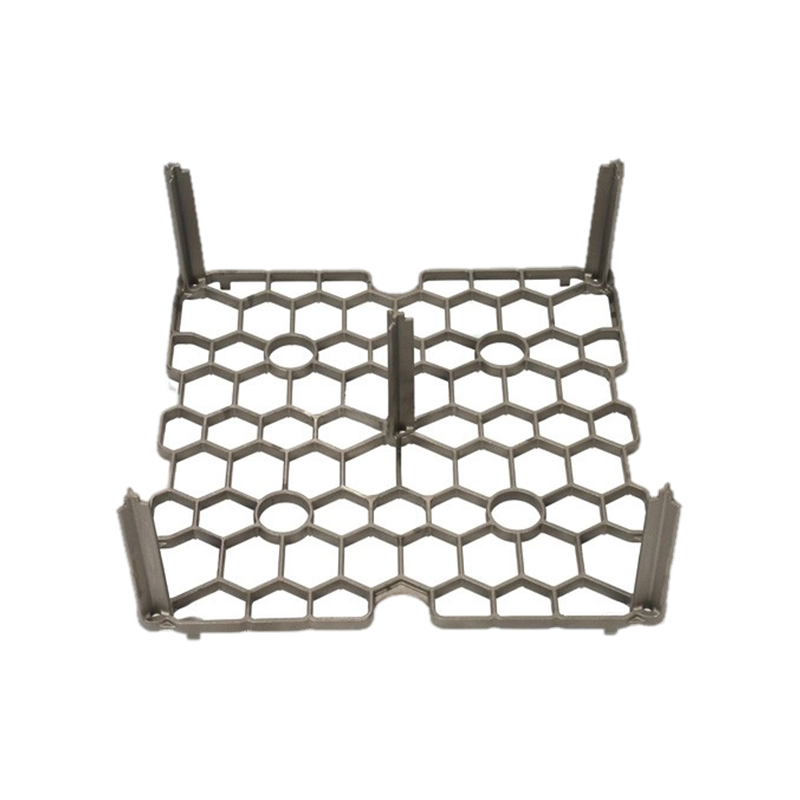
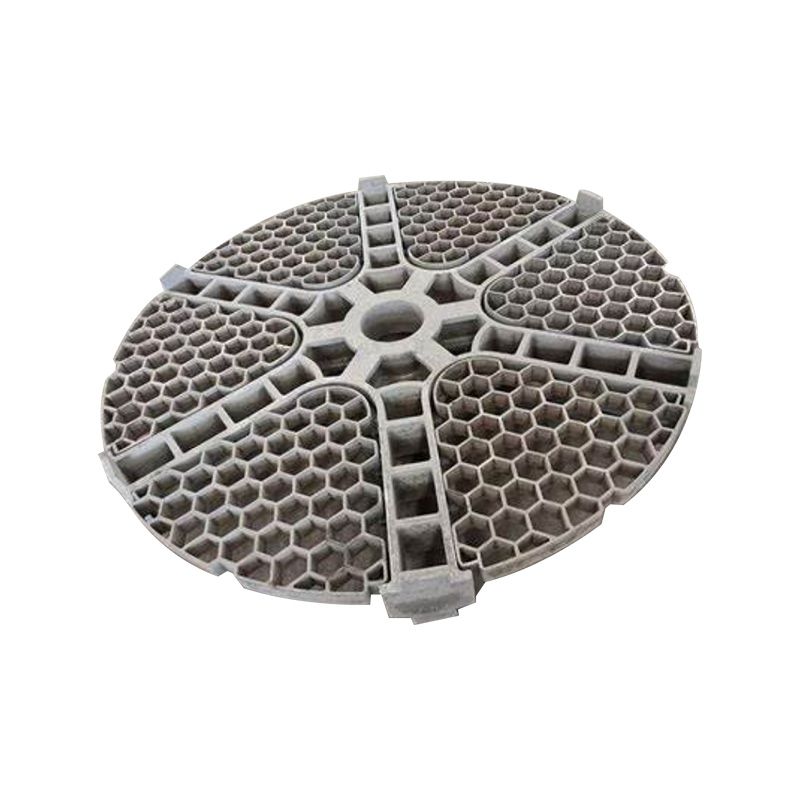
2. Investment Cast Baskets
Investment cast baskets are formed as a single, one-piece structure, which eliminates welded joints that would otherwise be the first point of failure under thermal stress. Industry sizing data shows cast baskets are available in dimensions up to roughly 48 inches long, 48 inches wide, and 18 inches high, with service temperature ratings spanning approximately 1,250°F to 1,900°F. Because there are no seams to crack or separate, cast baskets typically outlast fabricated designs in continuous, high-cycle production environments and are frequently specified for vacuum furnace applications.
3. Perforated Sheet Metal Baskets
Perforated sheet metal baskets are punched or laser-cut from solid alloy sheet, producing a rigid, low-flex structure well suited to fine, granular, or loose parts that could fall through a wider wire mesh. Sheet thicknesses used in fabrication commonly range from about 0.0625 inches up to 3 inches, allowing the same basic design to scale from lightweight dip baskets to heavy-duty structural carriers. This construction resists sagging under concentrated loads better than woven mesh, making it a common choice for degreasing and pre-treatment dip processes as well as heat treating.
4. Welded Rod and Frame Baskets
Welded rod and frame baskets combine a structural rod frame with a separate woven mesh liner, giving engineers the flexibility to reinforce only the load-bearing points while keeping the rest of the basket lightweight. This hybrid design is especially common for stacking baskets used in tower-style furnace loading, where multiple baskets are stacked several layers high and the frame must resist compressive load from the baskets above it without deforming.
Classification by Alloy Material
Material selection is just as important as construction style, since temperature tolerance, oxidation resistance, and load capacity vary significantly between alloy families. Repeated exposure above roughly 1,600°F can cause many standard stainless alloys to suffer accelerated oxidation, which compromises the passive oxide layer that normally protects the metal from corrosion.
| Alloy Family | Approx. Max Service Temp | Typical Use Case |
| 300-series stainless steel | Up to 1,600°F (871°C) | General-purpose, lower-cost applications |
| Nickel alloy 600 / Inconel | Up to 2,200°F (1,204°C) | Vacuum furnaces, corrosive atmospheres |
| Hastelloy / Haynes superalloys | 2,000°F (1,093°C) or higher | Extreme, continuous high-temperature cycles |
A closer look at the two most common alloy choices helps explain why material selection has such a direct effect on basket lifespan:
- 300-series stainless steel (including grade 330) offers strong load capacity and lower material cost, making it the default choice for processes that stay below roughly 1,600°F.
- Nickel alloy 600 has a melting point between approximately 2,470°F and 2,575°F, an ultimate tensile strength around 93 ksi at room temperature that drops to roughly 15 ksi at 1,600°F, and superior resistance to acidic and corrosive environments compared to standard stainless grades.
- Hastelloy and Haynes superalloys are reserved for the most demanding continuous-cycle furnaces, where both extreme heat and chemical exposure would degrade nickel-chromium alloys more quickly.
Classification by Furnace and Process Application
Beyond construction and material, baskets are also engineered around the specific furnace type and thermal process they will support.
Bulk Treatment Baskets
Bulk treatment baskets are designed for easy loading and unloading of large part quantities where precise positioning is not required. Inclined or reinforced walls are commonly added to these designs to distribute the load evenly and reduce deformation during transport between the loading station and the furnace.
Vacuum Furnace Baskets and Trays
Vacuum furnace baskets are typically built as flat base trays rather than deep-sided baskets, since parts in a vacuum environment are arranged to maximize surface exposure rather than stacked in bulk. These carriers are almost always specified in nickel alloy or Inconel due to the oxidation-free, high-temperature conditions inside vacuum chambers.
Water Quenching Baskets
Water quenching baskets require reinforced welded intersections at every joint, because the rapid thermal shock of quenching creates far more mechanical stress on the frame than a standard heating cycle. Without this reinforcement, standard mesh joints can crack or separate after only a limited number of quench cycles.
Custom-Shaped Positioning Baskets
Custom positioning baskets, such as those designed to center camshafts or other asymmetric parts, use investment casting to create a rigid support structure that holds each part in a fixed orientation throughout the entire treatment cycle. This prevents warping that can occur when long, thin parts are allowed to rest unsupported at a single contact point.
Woven Mesh vs. Cast Baskets: Which Should You Choose?
Both designs are widely used, but they solve different problems. The comparison below highlights where each construction method has the advantage.
| Factor | Woven Wire Mesh Basket | Investment Cast Basket |
| Upfront tooling cost | Lower | Higher |
| Resistance to weld-joint failure | Moderate | High (seamless) |
| Best load type | Small, uniform parts | Heavy, high-cycle loads |
| Typical lifespan under heavy cycling | Shorter | Longer |
| Ease of custom shaping | High | Moderate |
Key Specifications to Confirm Before Ordering a Basket
Specifying the correct basket requires more than choosing a construction type and alloy. Manufacturers typically request the following details before producing a custom design:
- Furnace chamber dimensions and any internal obstructions or clearance limits.
- Maximum operating temperature and the full thermal cycle profile the basket will experience.
- Process type — carburizing, nitriding, annealing, vacuum brazing, or salt bath.
- Workpiece weight and geometry, including whether parts are flat, cylindrical, or irregularly shaped.
- Required stacking height and number of basket layers per load.
- Atmosphere type — endothermic gas, nitrogen, vacuum, or salt.
- Expected annual cycle count and target service life for the basket.
Providing these details up front allows an engineering team to correctly match alloy grade, wall thickness, and mesh count to the actual thermal and mechanical demands of the process, rather than relying on a generic off-the-shelf design that may underperform.
Maintenance Practices That Extend Basket Service Life
- Inspect baskets regularly for early signs of warping, scaling, or joint cracking before they progress into structural failures.
- Clean baskets after each cycle to remove scale and debris that can accelerate localized corrosion.
- Replace or repair baskets once mesh sections show visible thinning rather than waiting for a full structural failure mid-cycle.
- Track cycle counts per basket so replacement schedules are based on data rather than guesswork.
- Repair mesh liners and reinforce frames when possible, since many baskets can be restored rather than fully replaced.
Frequently Asked Questions
What is the most common material used for heat treating baskets?
300-series stainless steel, particularly grade 330, is the most widely used material for general-purpose heat treating baskets because it balances cost, strength, and temperature resistance up to roughly 1,600°F.
Why do vacuum furnaces typically require nickel alloy baskets?
Vacuum furnaces often run at higher sustained temperatures than atmosphere furnaces, and nickel alloys such as Inconel 600 retain strength and oxidation resistance at temperatures up to approximately 2,200°F, well beyond the practical limit of standard stainless steel.
Can a heat treating basket be repaired instead of replaced?
Yes. Common repairs include replacing worn mesh liners, reinforcing frames at stress points, and correcting minor dimensional distortion, all of which can meaningfully extend a basket's usable service life.
How long does a typical heat treating basket last?
Service life depends heavily on alloy choice, operating temperature, atmosphere, and loading practices, but well-specified baskets in the correct alloy for their process can sustain thousands of thermal cycles before requiring replacement.
Do all heat treating baskets need to be custom designed?
Not necessarily. Standard baskets in common sizes work well for general-purpose processes, but custom designs are recommended whenever part geometry, furnace dimensions, or atmosphere chemistry fall outside typical off-the-shelf specifications.
Bottom Line
The right heat treating basket comes down to matching construction method and alloy to the actual demands of your furnace and process. Woven wire mesh baskets remain the most versatile and cost-effective option for general bulk treatment, investment cast baskets deliver the longest service life under heavy, repeated cycling, and specialized alloys like nickel 600, Hastelloy, and Haynes are reserved for the most extreme temperature and corrosion conditions. Matching these variables correctly from the start reduces part distortion, extends basket lifespan, and keeps furnace operations running without unplanned downtime.