Shunda Road, Lincheng Town Science and Technology Industrial Park, Xinghua City, Jiangsu Province

 English
 русский
 Español
 عربى

Crusher jaw plate casting is the foundry process that produces the two wear plates doing the actual crushing in a jaw crusher: the fixed jaw die and the moving (swing) jaw die. Get the alloy, the feeding design and the heat treatment right and a plate wears smoothly for a full production season; get one of them wrong and the same plate cracks at the tooth root or wears through in a few weeks.
That is the short answer most buyers need before they open a drawing. Three variables decide the outcome, and they do not carry equal weight:
- Alloy and heat treatment — in our experience roughly half of total wear life.
- Casting soundness (risers, chills, gating) — decides whether the plate survives impact at all, whatever the hardness reads.
- Tooth profile and fit to the feed — decides how the crushing load is distributed across the surface.
The rest of this guide works through those three, plus the tolerances and acceptance checks worth writing into a purchase order.
Content
- 1 What a Jaw Plate Casting Actually Is
- 2 Material Choice Decides Most of the Wear Life
- 3 Risers and Feeding: Where Jaw Plate Castings Fail Before They Wear
- 4 Which Casting Route Fits a Jaw Plate
- 5 Heat Treatment and the Records That Prove It
- 6 Tooth Profile: Matching the Plate to the Feed
- 7 What to Put in the Purchase Specification
- 8 Wear Life, Rotation and Replacement Signals
- 9 Frequently Asked Questions
What a Jaw Plate Casting Actually Is
A jaw plate casting is a heavy-section wear casting — thick at the mounting lug and the tooth root, thin at the tooth tip, and awkward to feed because the mass is unevenly distributed. That geometry, not the final machining, is what makes it a casting problem.
| Component | Position in the crusher | Typical cast weight | Foundry-critical features |
|---|---|---|---|
| Fixed jaw die | Bolted to the stationary frame jaw | 300–3,000 kg depending on crusher size | Flat backing face, sound lug area, even tooth height |
| Swing jaw die | Mounted on the moving jaw stock | 300–3,000 kg | Curved or stepped backing, deep corrugation, riser placement |
| Cheek plates and side liners | Crushing chamber side walls | 30–200 kg | Flatness, hole positions, wear allowance |
Two details matter at the drawing stage. First, tooth profiles are usually cast to near-final form, so the pattern carries the geometry — a poorly made pattern shows up as uneven nip angles on every plate in the batch. Second, mounting faces and bolt holes are normally machined after casting, which means the casting needs enough stock and a stable, stress-relieved structure to machine cleanly.
Material Choice Decides Most of the Wear Life
For most quarry, recycling and demolition feeds, austenitic high manganese steel (11–14% Mn, the classic Hadfield grade) is still the default because it work-hardens under impact while staying tough enough to swallow tramp metal; the exception is abrasive, low-impact feed, where a martensitic or low-alloy cast steel holds hardness better.
| Grade | Hardness as supplied | Behaviour in service | Best suited to | Watch-outs |
|---|---|---|---|---|
| Hadfield manganese steel (11–14% Mn) | About 180–220 HB | Work-hardens to roughly 450–550 HB in the top 10–15 mm; very tough | Mixed quarry feed, concrete recycling, high-impact crushing | Must be water toughened; check for grain-boundary carbides |
| Modified manganese (higher C, Cr additions) | About 200–250 HB | Better abrasion resistance at moderate impact | Granite, basalt, hard abrasive rock | Narrower heat-treatment window; harder to machine |
| Martensitic alloy cast steel (Cr-Mo) | About 45–55 HRC | Constant hardness, lower toughness | Abrasive feed with small top size and little tramp metal | Can fracture on uncrushables; specify impact testing |
| Low-alloy carbon cast steel | About 250–300 HB | Cheap, predictable, short life | Light duty, low-volume or temporary plants | Wears fast on silica-rich feed |
The hardness number on its own tells you very little. A manganese plate that has been properly solution-treated starts near 200 HB and hardens in service; a plate with the same starting number but continuous carbides at the grain boundaries will spall instead of work-harden, and often fails within days. Ask what the supplier measured, where they measured it, and on what coupon.
Risers and Feeding: Where Jaw Plate Castings Fail Before They Wear
Most jaw plate castings that fail early were never sound. Shrinkage porosity hides at the heaviest section — behind the corrugation and at the transition into the mounting lug — and a plate with internal voids cracks there long before the tooth faces are worn out.
Directional solidification is the whole job. The practical controls are:
- Size the riser from the feeding modulus of the heaviest section, not from the plate's average thickness; a common starting point is a riser modulus at least 1.2 times the section it feeds.
- Place chills or a chill block behind the lug so that section sets before the riser does.
- Gate bottom-up through a filter to keep slag and sand out of the crushing face, which is the surface the customer sees.
- Pour inside a narrow temperature window — typically around 1,430–1,470 °C for manganese steel — since too cold means misruns at the tooth tips and too hot means coarse structure and hot tears.
- Run a solidification simulation before the pattern is cut, and confirm the result on the first article with ultrasonic testing or sectioning.
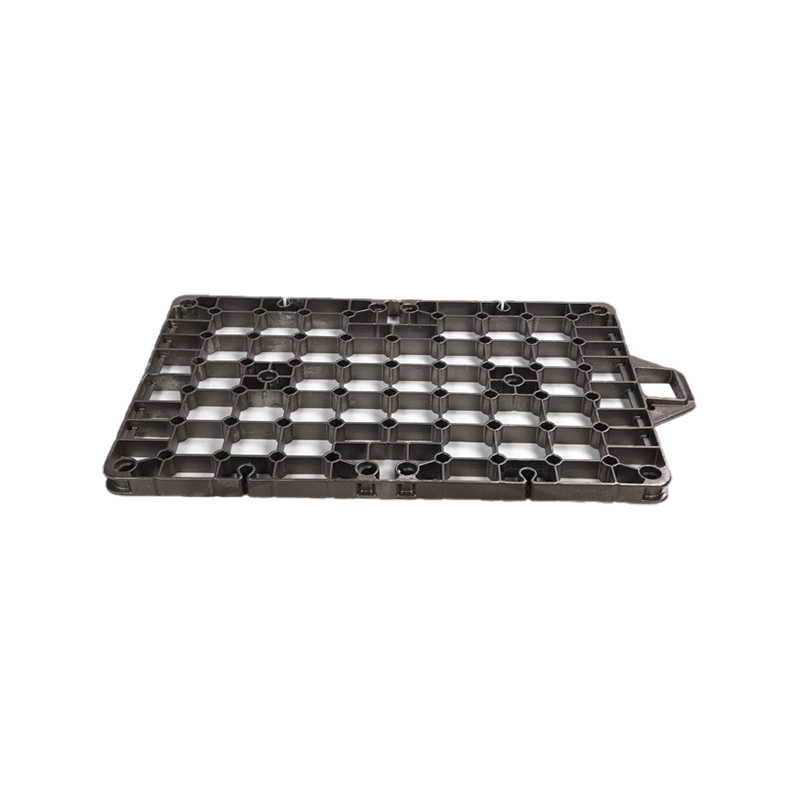
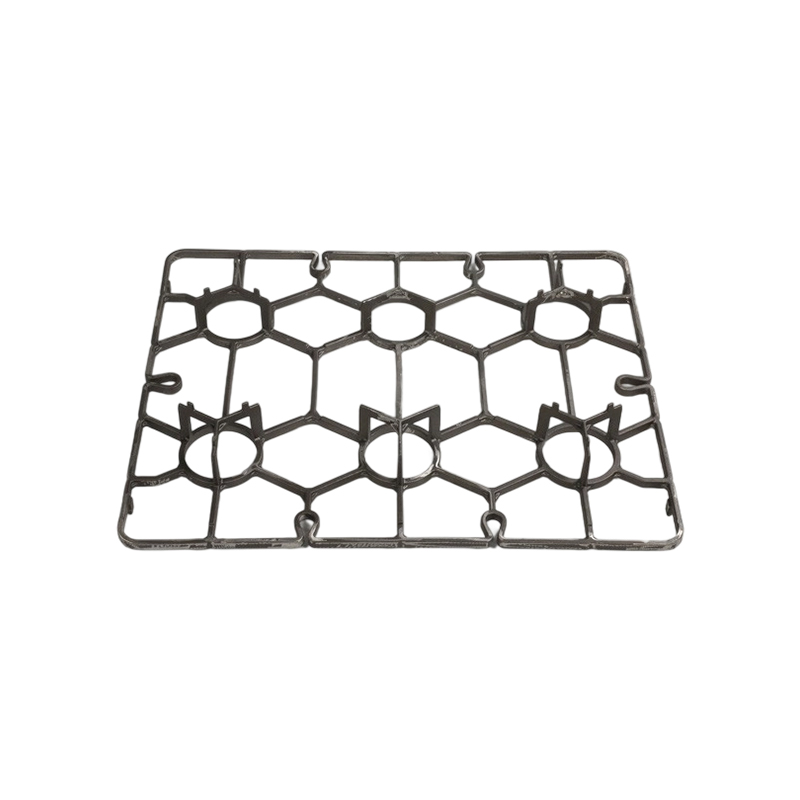
This is the same discipline used for other thick, plate-shaped wear castings, including the wear liner and grate plate work in our range.
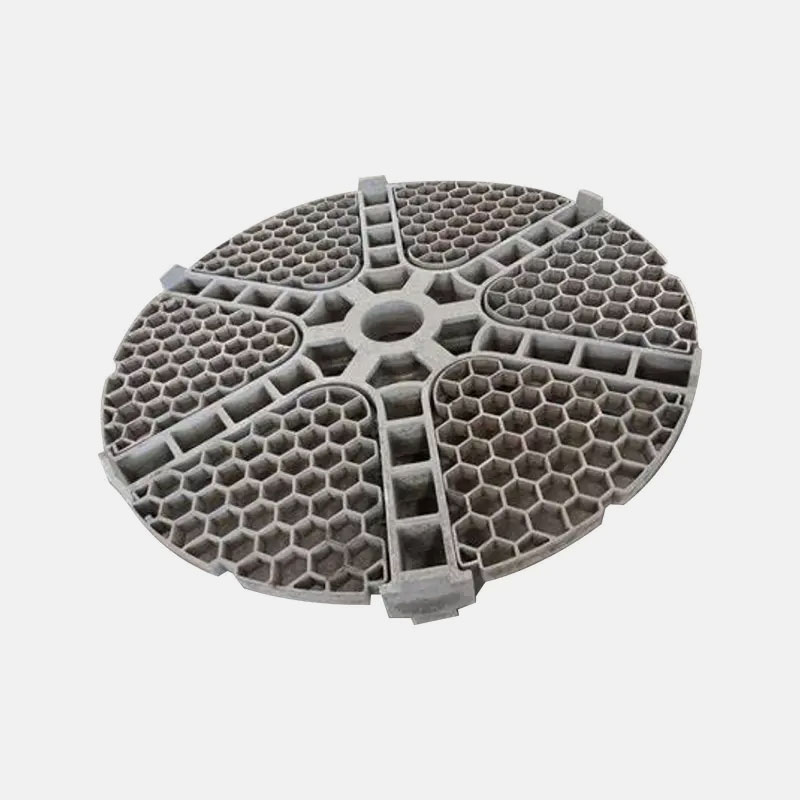
 Heat-resistant steel casting grate cooler grate plate, grate bar, liner plateThe heat-resistant steel casting grate cooler components, including grate plates, grate bars, and liner plates, are essential parts of cooling systems in high-temperat...View Product →
Which Casting Route Fits a Jaw Plate
Resin-bonded sand casting covers the widest size range and is the usual route for jaw plates above roughly 500 kg, because thick sections need a mould that accepts chills and a heavy riser without collapsing.
Lost foam casting — where a foam pattern is vaporised by the incoming metal — works well for repeatable plate profiles in the medium size range, where dimensional consistency and reduced machining stock matter more than maximum section thickness. If your order repeats the same two or three plate sizes, it is worth costing both routes against each other. Our lost foam casting product range shows the kind of plate-type and liner-type parts this process handles, and this explanation of how lost foam casting works covers the pattern and coating details that affect surface quality.
Whichever route is used, the pattern belongs to the buyer in most contracts. Confirm ownership, storage and the number of shots guaranteed before you place a first order.
Heat Treatment and the Records That Prove It
Water toughening is not optional for manganese plates: heat to roughly 1,050–1,100 °C, hold about one hour per 25 mm of section, and quench in water while the plate is still above about 950 °C; anything that cools slowly in the mould will carry carbides and crack early.
Alloy and martensitic grades go the other way — quench and temper to a target of about 45–55 HRC, with a tempering temperature chosen to retain toughness rather than to maximise hardness. In both cases, buy the records along with the plate:
- A hardness map with at least five defined points per casting.
- A test coupon poured from the same heat and treated in the same furnace load.
- Impact test results where tramp metal is a realistic risk.
- A microstructure statement for manganese steel: fully austenitic, no continuous carbide network.
- Dimensional report on the mounting face and bolt-hole pitch, since poor fit distorts the plate and accelerates uneven wear.
Tooth Profile: Matching the Plate to the Feed
The tooth profile sets the nip angle and the crushing load per tooth, so the right profile is the one that matches top feed size and target product size — not the one that looks most aggressive on a pallet.
| Profile | Character | Suited to |
|---|---|---|
| Corrugated (standard) | Moderate tooth depth, good grip, even wear | General quarry and recycling feed |
| Quarry / tall tooth | Deep teeth, high nip, strong bite on large lumps | Primary crushing of coarse, blocky rock |
| Toblerone (triangular) | Sharp alternating peaks, aggressive nipping | Sticky or slabby feed that tends to slide |
| Flat / smooth | Low grip, used for fine reduction or special duties | Secondary duties, controlled product shape |
Mixing profiles across the fixed and swing sides is legitimate and sometimes useful — a corrugated fixed plate against a taller-tooth swing plate changes the load pattern — but it should be a deliberate decision recorded on the drawing, not a substitution made at the foundry.
What to Put in the Purchase Specification
A jaw plate purchase order should specify alloy, hardness measurement method, soundness acceptance and dimensional tolerance explicitly; leaving any of these to "standard practice" is how batches end up rejected at goods-in.
| Item | What to state | Example acceptance |
|---|---|---|
| Alloy grade | Full designation plus chemical range | 11–14% Mn, C and Cr ranges on drawing |
| Hardness | Method, location, number of readings | Five points per plate, defined face, ±30 HB spread |
| Soundness | Inspection method and rejection criteria | No visible porosity on machined faces; UT on lug area for critical plates |
| Dimensions | Tolerances on thickness, pitch, flatness | Flatness within 1–2 mm on the backing face; bolt pitch per drawing |
| Marking and traceability | Heat number, casting date, part number | Cast or stamped on a non-wearing face |
| Documentation | Certificates, heat-treatment chart, first-article report | Submitted with each shipment |
Wear Life, Rotation and Replacement Signals
Rotate or replace jaw plates before the tooth profile disappears; a worn plate raises the closed-side setting, cuts throughput and loads the frame, so "running it to the end" usually costs more than the plate.
Practical signals that a change is due:
- Throughput falls noticeably at the same closed-side setting.
- The discharge gap can no longer be adjusted back to specification.
- Cracks longer than about 20–30 mm appear at the lug or tooth root.
- One end is at the wear limit while the other is barely marked.
| Symptom | Likely cause | Action |
|---|---|---|
| Even wear but short life | Alloy or heat treatment below specification for the rock type | Review hardness and microstructure records; consider a modified manganese grade |
| One end worn, one end new | One-sided feeding, or plates never rotated | Fix the feed arrangement; rotate at roughly half wear |
| Crack at the mounting lug | Shrinkage porosity, tramp metal, over-torqued bolts | Ultrasonic test the next batch; check bolt torque values |
| Polished, glazed surface | Feed too fine for the tooth profile | Change to a profile with more nip |
| Breakage across the middle | Uncrushable passed through, or an unsound heavy section | Review the sectioning or UT result on the failed plate |
Frequently Asked Questions
How long should a cast jaw plate last?
In normal quarry duty, expect roughly 500–1,500 operating hours per set, driven far more by feed abrasiveness and feed size than by the plate alone. Silica-rich, abrasive rock with a correct manganese plate sits at the low end; clean limestone with good nip geometry sits at the high end.
Is a harder jaw plate always better?
No. Hardness without toughness moves the failure mode from gradual wear to sudden fracture, and a cracked plate stops the plant the same day. Match the alloy to the impact level in the chamber first, then optimise hardness.
Why do manganese plates sometimes wear out before they work-harden?
Usually because the crushing load never gets high enough to harden the surface — fine feed, small reduction ratios and gentle settings all reduce work hardening. In those duties an alloy steel plate often outlasts manganese.
Can a worn plate be used as a pattern?
Only if the wear is measured and compensated. A worn plate reproduces its own distortion and shrinkage allowance errors, so a proper pattern is normally cheaper than the scrap caused by copying a used part.
What is the single most useful check at goods-in?
A hardness map taken at the locations named in the specification, read alongside the heat-treatment chart. Those two documents catch most of the failures that would otherwise appear in the first month of service.
Jaw plate casting rewards buyers who specify precisely and inspect early. Fix the alloy, insist on a feeding design that keeps the lug sound, verify the water toughening with records rather than a single hardness reading, and rotate the plates at half wear. That combination typically adds more service life than any single upgrade to the plate itself.