Shunda Road, Lincheng Town Science and Technology Industrial Park, Xinghua City, Jiangsu Province
 English
 русский
 Español
 عربى
عربى
Three months into a liner campaign, the mill runs normally, the screen shows the same feed rate as commissioning day, and nothing looks wrong. Then the lab report arrives: product is coarser, power draw has drifted a few percent lower, and the lifter bars in the first chamber have rounded off. Nothing has failed, yet the mill has quietly stopped doing the work it was paid to do.
The short answer: ball mill liners are replaceable castings bolted inside the mill shell, heads and discharge end. They protect the shell from impact and abrasion, lift the grinding media so the charge breaks ore, and control how pulp travels toward the discharge. Material and profile decide how long they last and how well the mill grinds; fit and installation decide whether they ever reach the wear life they were designed for.
Here is the order that matters: function, material, profile, installation, monitoring, and the checks to run before you place an order.
Content
- 1 What a Ball Mill Liner Is and What It Really Does
- 2 Material Selection: Match the Alloy to the Impact, Not to the Hardness Number
- 3 Profile and Chamber: The Variables That Move Throughput
- 4 Installation Tolerances: Where Most Bad Liner Sets Are Born
- 5 Wear Monitoring: Three Checks That Prevent Surprise Shutdowns
- 6 Buying Liners: A Foundry Checklist
- 7 Frequently Asked Questions
- 8 The Short Version
What a Ball Mill Liner Is and What It Really Does
A ball mill liner is a wear-resistant lining that sits between the grinding charge and the mill body. It is a consumable, but it is also a working part of the grinding circuit, because a worn profile changes the motion of every ball in the mill.
- Shell protection: absorbs impact and abrasion that would otherwise destroy the mill body.
- Energy transfer: lifter bars raise the charge and release it onto the toe of the pile, breaking ore by impact and attrition.
- Trajectory control: bar height and face angle decide whether the charge cataracts or cascades.
- Pulp control: plate pattern and grate slots influence how quickly material reaches the discharge end.
- Head protection: end liners and grate liners protect the mill heads and set the discharge opening.
Liner cost is usually only a few percent of total grinding cost, but liners influence a much larger share of it. Profile drives throughput, power draw and product size at once, so a cheap set that wears into a flat profile can cost more in lost output than it saved at purchase.
Material Selection: Match the Alloy to the Impact, Not to the Hardness Number
Conclusion first: choose liner material by the impact energy in the chamber and the abrasiveness of the ore, not by the highest hardness figure on a data sheet. A very hard plate that cracks under a 90 mm ball costs far more than a softer plate that wears evenly.
| Material | Hardness and typical fit | Main risk |
|---|---|---|
| Austenitic manganese steel (11 to 14% Mn) | About 200 HB as cast, work-hardens well above 500 HB; first chamber, coarse feed, large media | Wears quickly in fine grinding where impact is low |
| High-chromium white iron (Cr 12 to 26%, Mo) | 58 to 65 HRC; second chamber, fine grinding, regrind circuits | Cracking and spalling under large media or poor backing |
| Quenched and tempered alloy cast steel (Cr-Mo) | 300 to 400 HB; large mills with mixed impact and abrasion | Lower abrasion resistance than high chrome in fine duty |
| Rubber or composite liners | Rated by application rather than hardness; fine grinding, low temperature | Poor performance with sharp coarse feed, heat, or large media |
Two rules follow. High chrome is not an automatic upgrade: it wins in fine grinding and low-impact circuits, and loses in first chambers where large media deliver heavy point loads. Chemistry on paper also means little without casting soundness, because porosity or gas holes near a bolt hole become crack starters, and cracks in hard plate travel fast.
Quenched and tempered alloy cast steel is the usual compromise for large mills: hard enough for abrasive ore, tough enough to survive a broken ball or tramp metal. Set thickness by the wear allowance you actually need; every extra 10 mm adds weight, bolt load and cost.
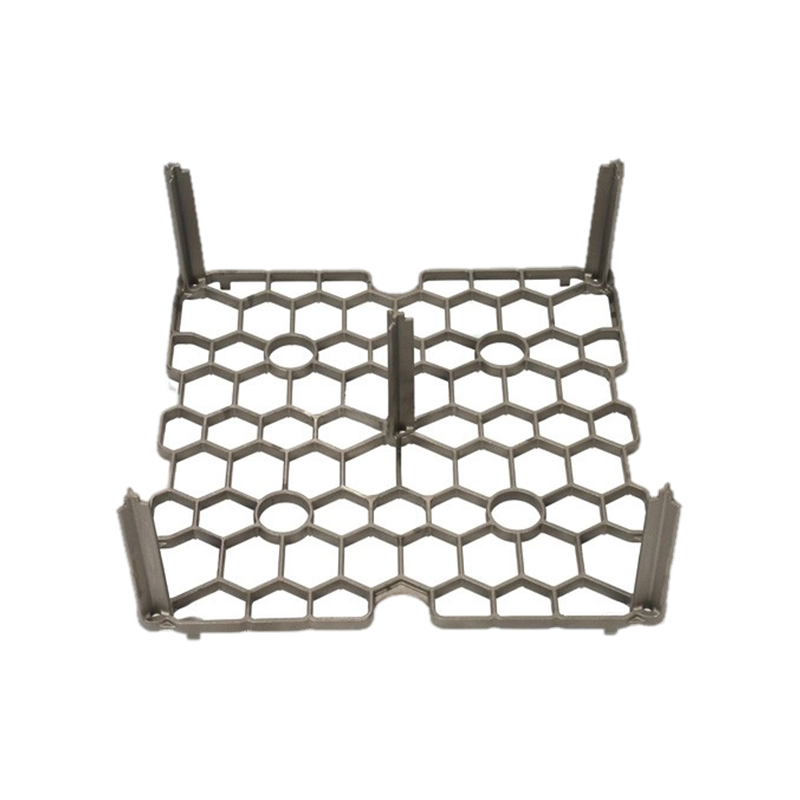
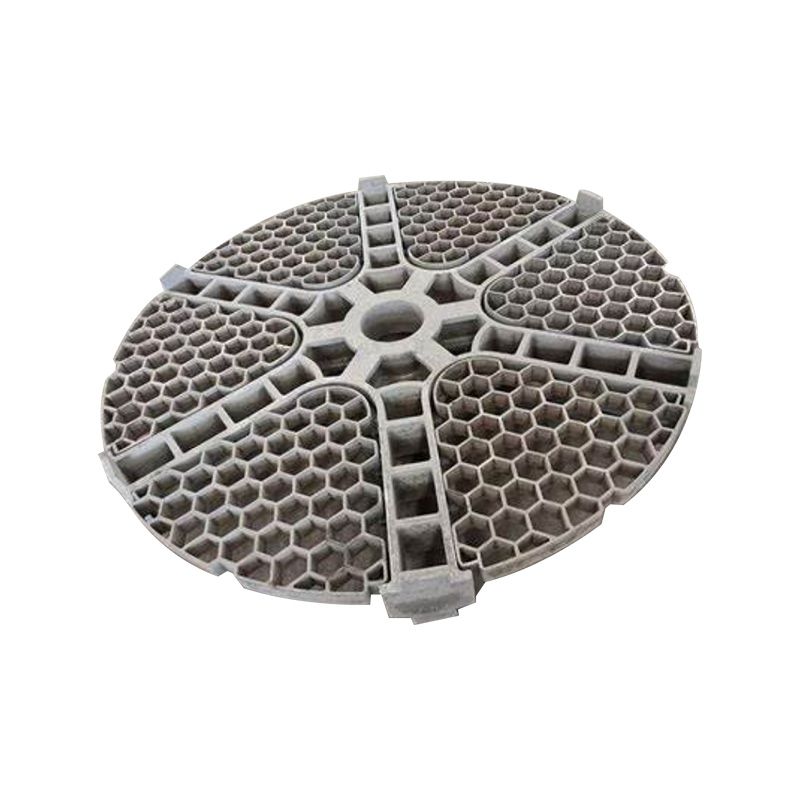
 Heat-Resistant Steel Cast Grate Cooler Component SetCustom grate plates, grate bars, and liner plates in heat-resistant steel for high-temperature cooling systems in cement, metallurgy, and power generation.View Product →
Profile and Chamber: The Variables That Move Throughput
Conclusion first: profile affects throughput more than material does. The same alloy cast into a different bar height can shift mill capacity by several percent and change the product size curve at the same time.
| Position | Typical profile | What to watch |
|---|---|---|
| First chamber shell | Step or wave plates, lifter bars 60 to 100 mm high, 30 to 45 degree face angle | Bar rounding; once the crest flattens, impact grinding is gone |
| Second chamber shell | Shorter bars, 30 to 50 mm, 15 to 25 degree face angle | Excess lift wastes power and over-grinds fine product |
| Feed end head | Heavy plates plus lifter bars | Impact cracking and loose bolts |
| Discharge end and grate | Grate plates with controlled slot width | Slot wear and peening, which change the product cut |
Profile has to match media size, ore and mill speed, which usually runs between 65 and 78 percent of critical. Charge filling degree, typically 25 to 40 percent of mill volume, sets how much lifting work is needed. Tall bars and a steeper face angle in the first chamber give the charge a higher release point and more impact energy; shorter bars and a shallower angle in the second chamber keep the charge cascading so the mill grinds by attrition instead of over-lifting.
Change one variable at a time. A new profile, a new media size and a new material introduced together produce a result nobody can explain, and the next campaign repeats the error.
Installation Tolerances: Where Most Bad Liner Sets Are Born
Conclusion first: many premature liner failures are installation faults rather than casting faults. Loose bolts, uneven gaps and missing backing cause more damage than most people expect.
- Clean the shell and heads. Scale, rust and old mortar create high spots that crack plates when bolts are tightened.
- Fit backing rubber or grout where the drawing requires it, so each plate seats evenly.
- Tighten bolts in a cross pattern from the center outward, to the supplier's figure, commonly 800 to 1200 Nm for M24 to M30 bolts, with a calibrated wrench.
- Re-torque after 24 hours of running and again after the first week, because new plates settle.
- Leave a 3 to 6 mm gap between adjacent plates for thermal expansion and to avoid edge peening.
- Check oval bolt holes and washers; a poorly sealed washer lets fine slurry wash out the backing.
A one-hour torque check after the first day of running is the cheapest insurance in the mill.
Wear Monitoring: Three Checks That Prevent Surprise Shutdowns
Conclusion first: thickness measurement at fixed points, power draw trend and product size together catch liner wear months before failure.
- Thickness: mark reference points at commissioning and replace the set when remaining thickness at the lifter crest reaches roughly 30 to 40 percent of the original.
- Power draw: a slow decline means less lift and less impact energy, even while the mill still sounds busy.
- Product size: coarser overflow at the same feed rate points to rounded bars rather than to the ore.
- Condition checks: inspect high-chrome plates for cracks and verify bolt torque at every planned shutdown.
Log readings against tonnes milled, not calendar days. One ore body gives six months of life, another eighteen.
Buying Liners: A Foundry Checklist
Conclusion first: buy on heat chemistry, casting soundness and dimensional repeatability, and expect documented evidence of all three.
- Chemistry and heat number on the certificate, matched to the plates delivered.
- Hardness readings at several points across the plate, not one value.
- Soundness checks around bolt holes and bar roots, visual and ultrasonic for critical plates.
- Dimensional report covering thickness, profile height, bolt-hole centers and hole ovality.
- Batch consistency: the same pattern and process for repeat orders.
- Lead time and spare stock, because a liner change cannot wait for slow delivery.
The casting process should suit the part, not the supplier's convenience. Plates with cast-in bolt holes and lifting lugs suit lost foam casting, which cuts machining on the bolt seats; heavy shell plates are commonly poured in resin sand; cylindrical sleeves and rollers are better made by centrifugal casting. A supplier who runs more than one process is easier to keep on schedule.
Frequently Asked Questions
What is the best material for ball mill liners?
There is no single best material. Manganese steel suits first chambers with large media and high impact, high-chromium white iron suits second chambers where abrasion dominates, and quenched and tempered alloy cast steel sits between the two for large mills with cracking risk.
How long do ball mill liners last?
It depends on ore, media size, mill speed and profile. In hard, abrasive ore with coarse media, six to twelve months is common; softer circuits can run two years or more. Track wear per tonne milled rather than per month.
How do I know when to replace liners?
Two triggers usually arrive first: remaining lifter-crest thickness at about 30 to 40 percent of original, and a measurable loss of throughput or power draw at unchanged feed. Waiting for a cracked plate turns a planned change into a shutdown.
Do liner profiles really change power consumption?
Yes. Taller bars lift the charge higher, raising power draw and impact breakage; shorter bars shift the mill toward attrition grinding. Change the profile one step at a time and measure the result.
The Short Version
Liners are a grinding variable, not a spare part. Match the alloy to the impact in each chamber, choose the profile for the media and the grinding stage, install and re-torque to specification, and measure wear against tonnes milled. Do that and a liner set stops being a recurring expense and becomes a controlled part of the grinding circuit.