Shunda Road, Lincheng Town Science and Technology Industrial Park, Xinghua City, Jiangsu Province
 English
 русский
 Español
 عربى
عربى
Heat treatment for casting is a controlled thermal cycle applied after solidification to modify the microstructure of a cast metal and achieve the required mechanical properties, residual-stress state, and dimensional stability. For most steel and high-alloy castings, this is not an optional extra; it is the step that turns an as-cast part into a reliable engineering component.
Content
- 1 What Is Heat Treatment in Metal Casting?
- 2 Why Is Heat Treatment Important for Castings?
- 3 Common Heat Treatment Processes for Castings
- 4 How to Choose the Right Heat Treatment Cycle
- 5 Heat Treatment Tooling: The Overlooked Variable
- 6 Common Heat Treatment Defects and How to Avoid Them
- 7 Frequently Asked Questions
What Is Heat Treatment in Metal Casting?
At its core, heat treatment consists of three stages: heating the casting to a defined temperature, holding it there for a period known as “soaking,” and then cooling it at a controlled rate. The heating and cooling rates, peak temperature, and soak time determine the final microstructure. For carbon steels, the target is usually austenitization around 850–950 °C, followed by a deliberately chosen cooling path. For stainless and superalloys, the process may include solution treatment at higher temperatures and subsequent aging to precipitate strengthening phases.
- Heating rate controlled to avoid thermal shock and distortion.
- Soaking time matched to section thickness, not just part weight.
- Cooling rate selected according to the required transformation product: ferrite, pearlite, bainite, or martensite.
Why Is Heat Treatment Important for Castings?
Heat treatment is important because it transforms the as-cast dendritic and segregated structure into a more uniform matrix with the strength, ductility, and stability required by the specification. Without it, a casting retains high internal stress and inferior mechanical properties.
- Residual stress relief to prevent distortion during machining and service.
- Improved mechanical properties, including tensile strength, yield strength, impact resistance, and ductility.
- Controlled hardness for wear resistance or ease of cutting.
- Better machinability through a softer, more consistent structure.
- Long-term stability for parts exposed to high temperatures, such as furnace rollers and heat-treatment fixtures.
Common Heat Treatment Processes for Castings
Every heat-treatment process is defined by a time-temperature path, and the choice among them is determined by the desired final microstructure and properties. The table below summarizes the most common cycles for steel castings; exact parameters always depend on alloy grade, section thickness, and the governing specification.
| Process | Typical heating range | Cooling method | Main purpose |
|---|---|---|---|
| Annealing | 850–950 °C | Furnace cool | Softening and machinability |
| Normalizing | 850–950 °C | Air cool | Grain refinement and higher strength |
| Quenching | 850–950 °C | Oil, water, or polymer quench | Hardening |
| Tempering | 150–650 °C | Air or furnace cool | Stress relief and toughness adjustment |
| Stress relieving | 550–650 °C | Slow cool | Residual-stress removal |
| Solution treatment + aging | 980–1200 °C + 480–900 °C | Quench + age | Precipitation hardening |
Temperature uniformity inside the load is more important than the setpoint on the controller. A difference of 10–20 °C between the center and the edge of the load can change the final hardness of the part by several HRC. That is why optimizing heat-treatment tray design for furnace temperature uniformity is one of the most cost-effective quality improvements a foundry can make.
How to Choose the Right Heat Treatment Cycle
Start with the required mechanical properties and the alloy data sheet, not with a generic recipe. This is especially important for castings because the as-cast structure is already affected by section size and cooling conditions in the mold.
Alloy Grade
The material data sheet gives the recommended austenitizing or solution treatment temperature. Chemical composition and carbon equivalent determine hardenability.
Section Geometry
Heavy sections require longer soak times and slower quench rates. Sharp transitions should be guarded against with controlled cooling.
Target Properties
The specification defines hardness, tensile strength, elongation, or impact toughness. The cycle must be selected to hit that range with the actual cast structure.
Service Environment
High-temperature, corrosive, or wear-heavy applications demand special considerations such as stabilization, precipitation hardening, or surface treatments.
For castings used in high-temperature environments, such as furnace rollers, kiln components, or heat-treatment tooling, the cycle should also stabilize the structure against long-term creep and oxidation. This is where experience with heat-resistant alloys matters: a foundry that routinely casts and heat-treats these materials knows how to balance strength and ductility.
Heat Treatment Tooling: The Overlooked Variable
Heat-treatment tooling directly influences heating and cooling uniformity, part distortion, and batch throughput, so it deserves the same engineering attention as the furnace program.
Stackable Baskets for Well-Type Furnaces
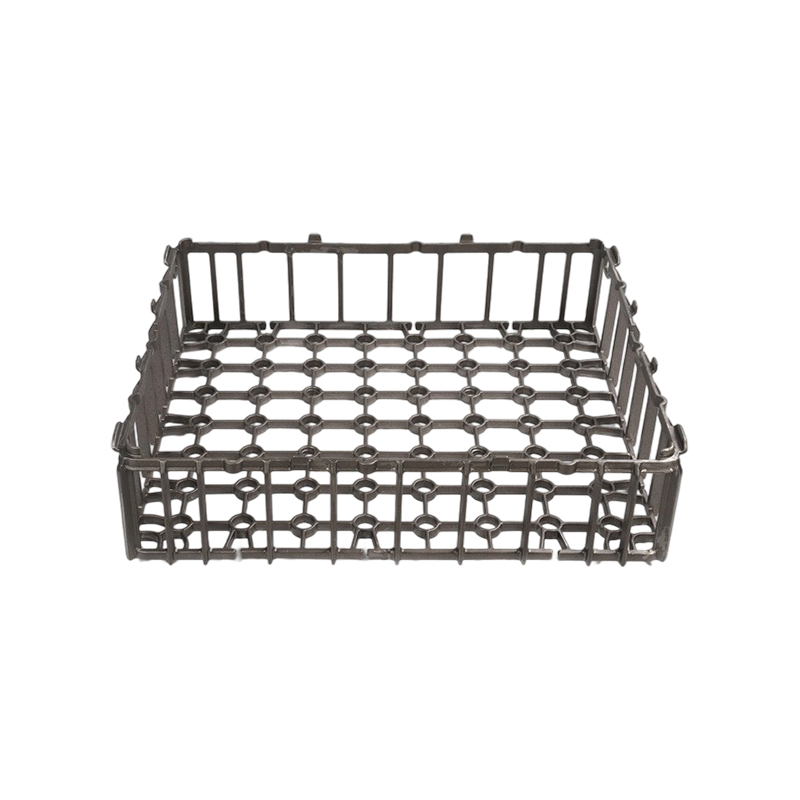
A stackable basket improves furnace utilization and temperature uniformity by leaving open gas paths between layers. Vertical well-type furnaces are common for batches of small or medium-sized castings, and a stackable well-type furnace basket can be stacked two or three levels high without sacrificing temperature uniformity.
 OEM/ODM Heat treatment stackable Basket for well-type furnace Supplier, CompanyAs China Heat treatment stackable Basket for well-type furnace supplier and OEM/ODM company, Xinghua Jinniu professional custom Heat trea...View Product →
Base Trays and Contact Area Control
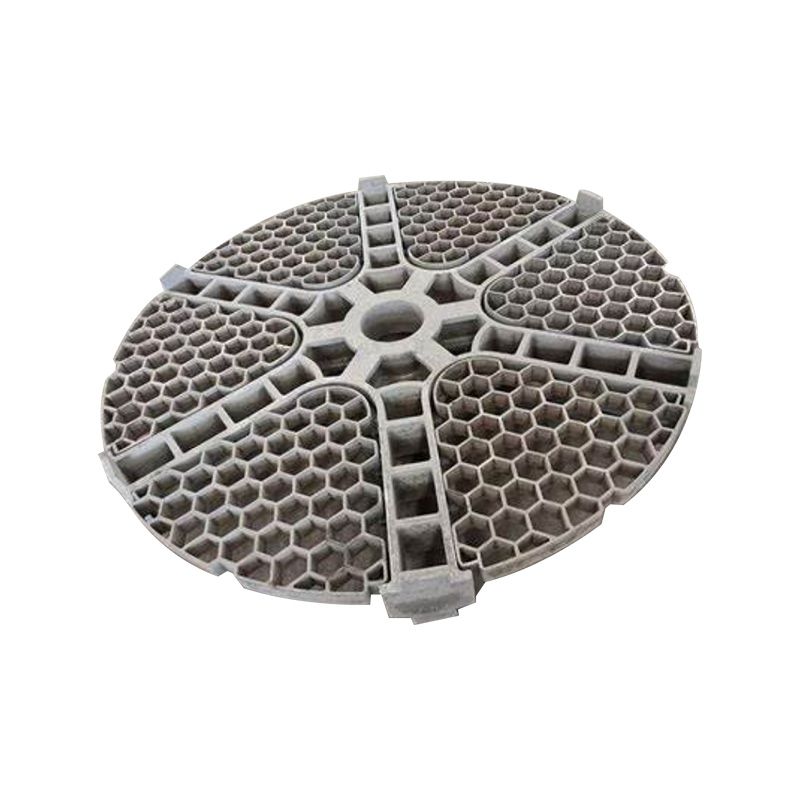
A base tray with reduced contact area prevents local hot and cold spots and is a critical factor in thermal uniformity. A stainless-steel cast base tray uses openings and raised supports to reduce the contact footprint while keeping the part stable. The relationship between contact area and heat flow is discussed further in this technical article on base tray contact area design.
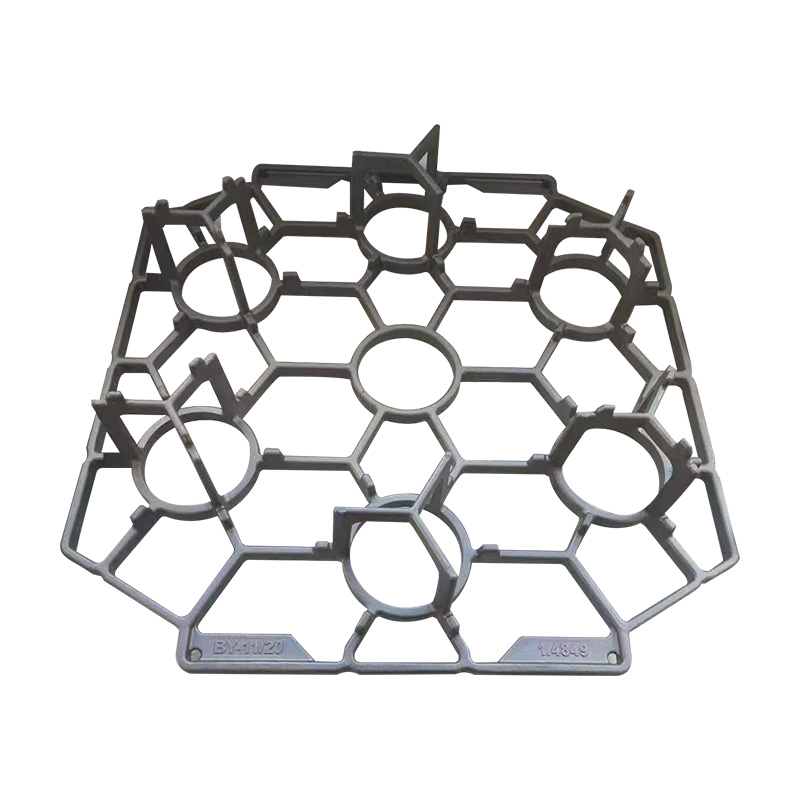 OEM/ODM Stainless Steel Cast Base Tray Supplier, CompanyAs China Stainless Steel Cast Base Tray supplier and OEM/ODM company, Xinghua Jinniu professional custom Stainless Steel Cast Base Tray. ...View Product →
Material Frames for Complex Geometries
Material frames support the part at defined points without blocking the furnace atmosphere, which prevents sagging and improves heat flow. A material frame for heat-treatment loading can be designed to fit the part contour, holding the casting in its correct shape while leaving the rest of the surface open to the furnace atmosphere.
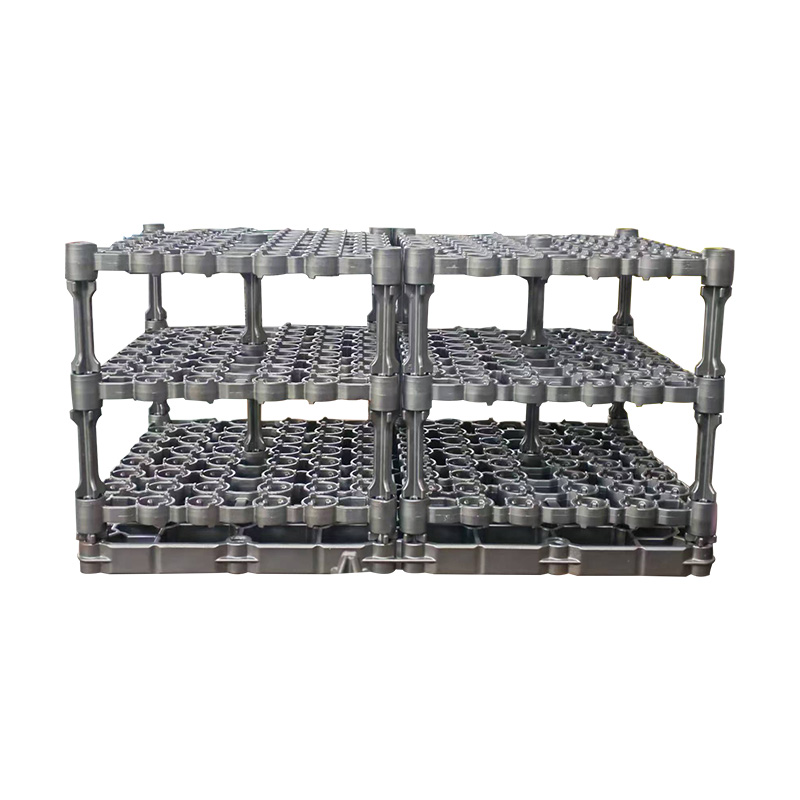 OEM/ODM Precision Casting Heat Treatment Material Frame Supplier, CompanyAs China Precision Casting Heat Treatment Material Frame supplier and OEM/ODM company, Xinghua Jinniu professional custom Precision Casti...View Product →
All three solutions are themselves precision castings in heat-resistant stainless steel, produced under the same quality controls as the parts they carry. In-house production allows the fixture geometry to be adjusted quickly when a customer introduces a new part family.
Common Heat Treatment Defects and How to Avoid Them
The most common heat-treatment defects trace back to uneven heating, uncontrolled cooling, or an unstable furnace environment, and each can be prevented with process and tooling changes.
- Distortion caused by uneven heating or too-rapid cooling. Proper fixturing and preheating reduce the risk.
- Cracking due to high thermal stress. Lower the quench severity and design out sharp internal corners.
- Oxidation and decarburization at high temperature. Protective atmosphere or vacuum is required for high-carbon and tool steels.
- Non-uniform hardness caused by poor load density or thermocouple placement. Reconfigure the load and improve gas circulation.
During vacuum heat treatment, fixture cleanliness and material composition also affect the outgassing behavior of the load. The degassing effect of heat-treatment trays under vacuum can change the surface quality of workpieces, so many vacuum cycles include an extended hold to let the fixture and parts release adsorbed gas.
Frequently Asked Questions
Do all castings need heat treatment?
No. Gray iron castings often run as-cast, and some aluminum parts are cast in a condition that already meets the specification. However, most steel castings, ductile iron castings, and high-alloy components need at least one thermal cycle to meet mechanical property requirements.
What is the difference between annealing and normalizing?
Annealing cools the casting slowly in the furnace, producing a soft, ferritic-pearlitic structure ideal for machining. Normalizing cools in air, producing a finer pearlite and higher strength. Choose normalizing when you need better mechanical properties and annealing when you need maximum softness.
Can heat treatment be repeated?
Yes, but not without risk. Repeated cycles can cause grain growth, surface decarburization, or excessive scaling. If the first cycle misses the target hardness, the part can often be re-heat-treated once, but the supplier should first evaluate the microstructure and the surface condition.
How can a buyer verify that a casting was heat treated correctly?
Ask for a certificate of heat treatment with time-temperature charts, hardness results, and, where required, tensile or impact test data. A reliable supplier can also show the furnace log and the standard used. If the casting later distorts during machining, stress-relieving may have been skipped or shortened.
The most cost-effective way to get heat treatment right is to select a casting supplier that controls the entire heat-treatment loop, including fixturing, batch loading, and verification. At Xinghua Jinniu Machinery Manufacturing Co., Ltd., heat treatment is part of the same quality system as melting, casting, and finishing, so the cycle, the tooling, and the inspection data stay under one roof.